












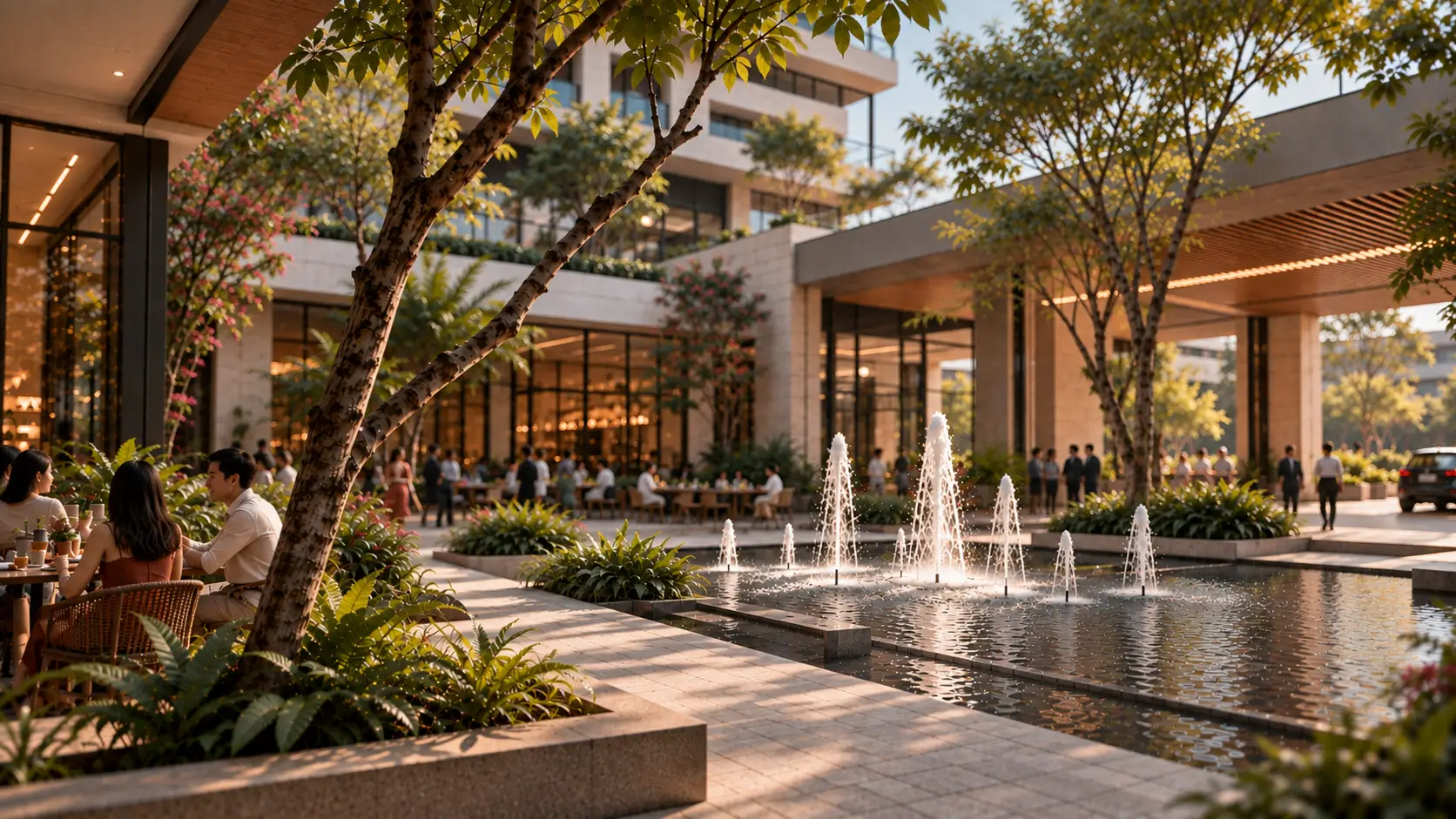
- Water features can help organize circulation and establish clearer transitions within arrival areas.
- Their placement can influence how visitors approach, slow down, orient themselves, and move toward an entrance.
- Reflecting pools, fountains, linear water elements, and landscaped basins can perform different spatial roles depending on their location.
- Effective water features are coordinated with architecture, landscape, pedestrian routes, vehicle movement, and sightlines.
- In Philippine developments, water can contribute to distinctive arrival spaces without needing to become the dominant feature of the design.
Water as Part of the Arrival Sequence
Arrival areas have several jobs to perform at once. They guide vehicles and pedestrians, establish clear entrances, introduce the architecture, and create a transition from the surrounding road or development into the property itself. In hotels, resorts, residential communities, and mixed-use developments, water features can become part of this spatial organization rather than functioning only as landscape decoration.
Their effect depends heavily on placement. Along an approach, a linear water feature can strengthen a sightline and reinforce the direction toward the building. At a turning point or arrival court, moving water can establish a recognizable landmark and help visitors understand where circulation changes. Beside a drop-off, a shallow basin can provide visual separation between vehicles and pedestrians while maintaining an open connection to the entrance.
Closer to the building, water can take on a different role. Reflecting pools and narrow channels can emphasize the transition from exterior space to a lobby, covered walkway, or courtyard. Rather than competing with the architecture, these elements can extend its geometry into the landscape and make the entrance easier to recognize.
The effectiveness of these features comes from how they work with the larger composition. Scale, sightlines, pedestrian routes, vehicle movement, planting, shade, and the position of the entrance all determine whether water strengthens the arrival space or simply occupies it.
Designing for Movement, Not Just the View
Arrival spaces are experienced from changing positions and at different speeds. A visitor might first see the architecture while approaching by vehicle, encounter the entrance again from the drop-off, and finally experience the space on foot. A well-positioned water feature can connect these stages by remaining visible or revealing itself gradually as visitors move through the site.
This can be particularly useful in larger developments where the main entrance is not immediately apparent. A long basin aligned with a lobby can reinforce its position from a distance, while a fountain at the end of an approach road can identify a point where vehicles slow down, turn, or enter an arrival court. Water can complement signage and architectural cues rather than replacing them.
Visibility can also be deliberately controlled. A water feature partially framed by planting or architecture creates a different sequence from one presented immediately at the property entrance. Similarly, water positioned beyond a covered drop-off can draw attention through the arrival space toward a lobby, courtyard, or landscape beyond.
Philippine developments demonstrate how water can operate at very different scales within a larger spatial sequence. At NUVALI in Laguna, the estate’s four-hectare lake forms part of a broader lakeside environment connected to pedestrian and cycling routes, recreation, retail, and other destinations. Rather than functioning as an isolated decorative feature, the water helps establish a recognizable setting within the development.
These decisions allow the practical requirements of circulation to contribute to the character of the development. Visitors still need to understand where to enter and how to move through the site, but those movements can be incorporated into a more considered architectural experience.
When Water Marks the Threshold
The change from vehicular movement to pedestrian space creates an important design condition within many arrival areas. Visitors leave the driveway or drop-off, orient themselves toward the entrance, and begin interacting with the building at a slower pace.
Water can help distinguish this transition without closing spaces off from one another. A shallow basin between a driveway and lobby can visually separate pedestrian and vehicular areas while preserving views across the entrance. Narrow channels alongside covered walkways can reinforce pedestrian routes, while a water feature within an arrival courtyard can provide a reference point around which entrances and pathways are organized.
Scale becomes especially important at this point. A large feature may dominate a relatively compact entrance, while a smaller element aligned with a canopy, walkway, or façade can achieve a stronger relationship with the architecture. Materials, edges, changes in level, and proximity to pedestrian routes also affect whether the water feels integrated into the arrival space.
The result does not need to be monumental. The purpose is to make the transition between approach, drop-off, and entrance more understandable while giving those spaces a coherent architectural identity.
Sound and Atmosphere Along the Approach
Water affects an arrival space through more than its appearance. The sound produced by falling, flowing, or gently moving water can influence how an entrance feels, particularly where the surrounding environment includes vehicle movement and other sources of background noise.
Different types of movement create different effects. A still reflecting pool emphasizes visual calm, while a fountain introduces more noticeable sound and activity. A narrow channel with moving water can provide a quieter sensory element along a pedestrian route. The appropriate choice depends on the scale and character of the development rather than on the desire to make the feature as prominent as possible.
In hospitality environments, this can help establish a transition between an active drop-off and quieter interior or landscaped spaces. In residential developments, water near an entrance or clubhouse can contribute to a recognizable community arrival without requiring an oversized architectural gesture.
At the other end of the scale, The Fountain at Okada Manila demonstrates how water can become a defining element within the identity of a destination. Spanning 37,464 square meters and surrounded by the resort’s Crystal Corridor and Crystal Pavilion, the feature combines water, light, sound, architecture, and surrounding circulation into a much more theatrical experience.
Most developments do not require water at this scale. The more useful lesson is how the character of a water feature can respond to the intended experience of a place. A resort or entertainment destination may justify spectacle, while a residential community, hotel, or mixed-use development may benefit more from a quieter element that reinforces a view, route, courtyard, or threshold.
Water, Shade, and the Tropical Arrival Experience
In the Philippines, arrival areas must also respond to strong sunlight, high humidity, and seasonal rainfall. Water therefore needs to be considered alongside shade, planting, covered circulation, drainage, and materials suited to frequent exposure to moisture.
A water feature positioned beneath or beside a shaded entrance can create a different experience from one placed in a large exposed forecourt. Trees, canopies, arcades, and covered walkways can frame views toward water while also providing practical protection for pedestrians. During the rainy season, careful detailing becomes particularly important so that intentional water elements remain visually and functionally distinct from drainage and stormwater movement.
This makes coordination essential. Landscape architects, architects, engineers, and other project consultants need to consider circulation, waterproofing, maintenance access, drainage, safety, and planting as parts of the same arrival environment.
When these elements are resolved together, water can contribute to a distinctly tropical sense of arrival without relying on excessive landscaping or resort-style imagery. It becomes one component within a broader response to climate, movement, and place.
Designing Water as Part of the Architecture
Water features are most convincing when their role is established early enough to influence the surrounding design. Adding a fountain or reflecting pool to an already resolved entrance may improve its appearance, but it does not necessarily improve how the space works.
Several questions can help determine whether water has a meaningful role within an arrival area:
- What should visitors see first? The placement of water should support important views rather than obscure the entrance.
- How do vehicles and pedestrians move through the space? Water should reinforce circulation without creating unnecessary obstacles.
- Where does the arrival experience change pace? Turning points, drop-offs, courtyards, and building thresholds may offer opportunities for water to mark transitions.
- How will the feature perform over time? Maintenance, water quality, drainage, safety, and access need to be considered alongside appearance.
- Does the water strengthen the architecture? Its scale, geometry, materials, and position should have a clear relationship with the surrounding building and landscape.
The strongest arrival spaces do not depend on water alone. Architecture, landscape, circulation, shade, planting, lighting, and signage still need to work together. Water becomes valuable when it strengthens those relationships and gives visitors another way to understand the space.
They can reinforce sightlines, organize circulation, identify entrances, distinguish pedestrian and vehicular zones, and contribute to the atmosphere of an approach.
No. Smaller reflecting pools, channels, and basins can have a strong spatial effect when they are properly aligned with entrances, walkways, courtyards, or architectural elements.
Climate, rainfall, drainage, shade, waterproofing, maintenance, pedestrian safety, planting, and the relationship between the water feature and surrounding circulation should all be considered.
Yes. Residential developments, mixed-use projects, institutional buildings, commercial properties, and other developments can use water where it supports the character and organization of the arrival space.
Fulgar Architects works with developers and property owners to shape architecture, landscape relationships, and spatial experiences around the needs and character of each development. Contact our team to discuss how thoughtful planning and architectural design can strengthen the arrival experience of your project.